
Description
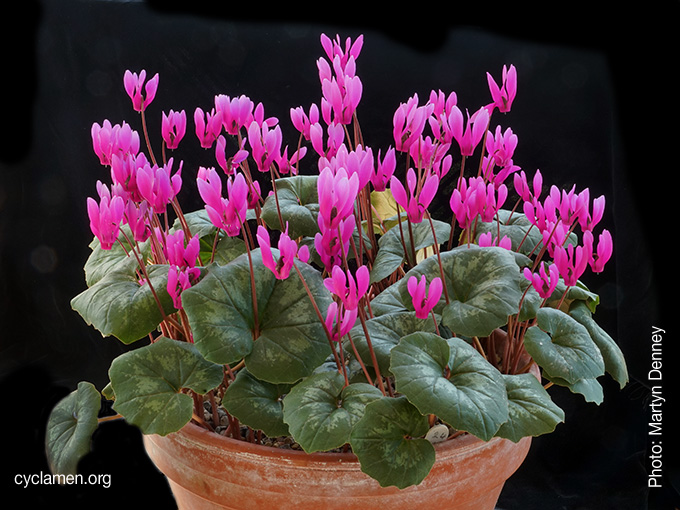
Flowers appear in spring, in the wild from March to May, the fragrant flowers are a deep glowing ruby red in the best plants, though mid-pink colours are known. There is a basal blotch on the nose but this is often hardly noticeable as it differs very little from the main colour of the flower. An entirely white-flowered variant has been found in nature but has not been named. The corolla lobes are reflexed, 15-30mm long, 5-10mm wide, with pointed tips generally 180 degrees twist, no auricles at the base.
Leaves appear in early spring, full grown by flowering time, thin blade, oval to triangular, edges faintly lobed often with scalloped margins, dark or grey green background with pale green, grey-green or silver markings, underside pale green or purplish, 2-15cm long, 1.5-15cm wide.
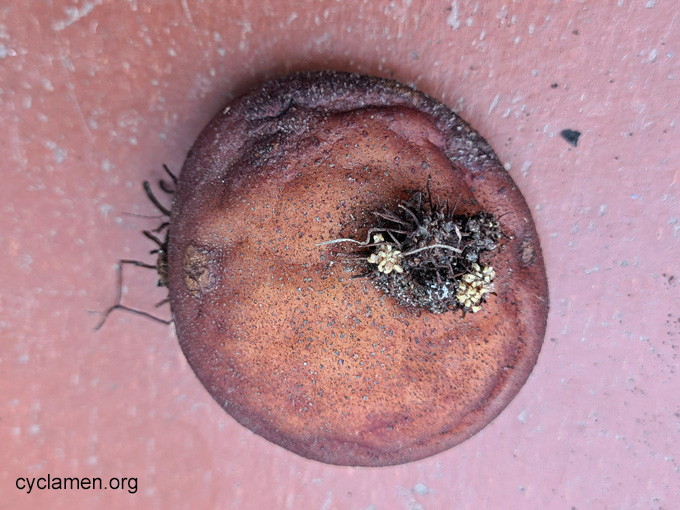
Tuber
Tuber a compressed sphere, medium sized at maturity, up to 7cm diameter, brown, smooth, with fine velvety hairs, becoming rough with age, branching thin (0.5mm) diameter roots arise from the centre of the underside.
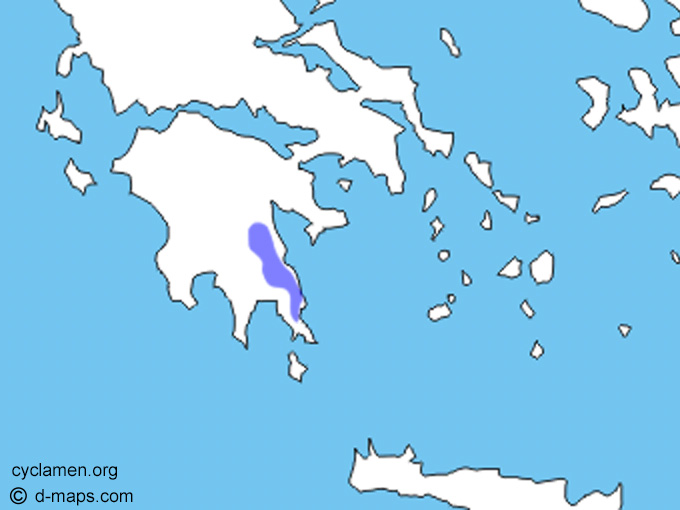
Distribution
Cyclamen vividum is endemic to the Greek Peloponnese where it grows on the eastern and southern sides of the Parnon Mountain range. There is also a small population on the island of Kythera just south of the Peloponnese.
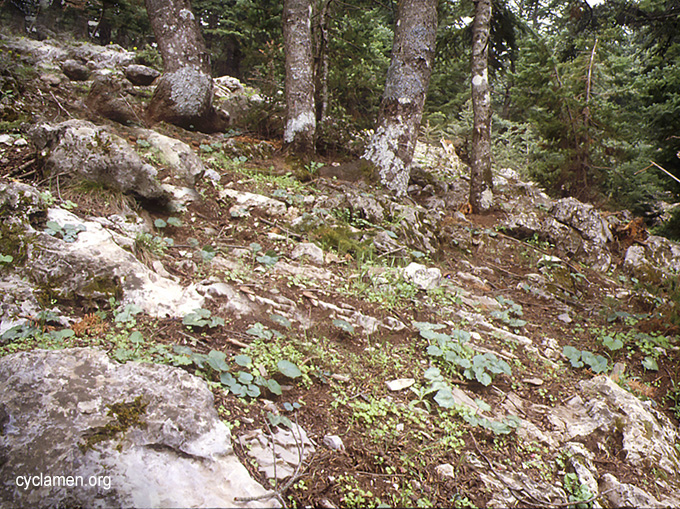
Habitat
Cyclamen vividum is often found growing in light open woodland, but is also found in more open rocky areas from 400-1700m, which can become quite dry in summer.
Cultivation
Cyclamen vividum is not particularly hardy but when planted deeply, 10-15cm, in a sheltered and damp (not wet) situation, could make a good garden plant in milder parts of northwest Europe. In colder climates they grow well as pot plants in a frost-free greenhouse, performing best when lightly shaded, although it will take more sun than C. pelonnesiacum and C. rhodium. No cultivars have been named.


